
Moving Magnet VS Moving Coil Cartridges
For many people, upgrading from a Moving Magnet (MM) cartridge to a Moving Coil (MC) cartridge is a key aspiration as they make the hifi upgrade ‘journey’ ( I promise that’s the last time I’ll use that word. 🙂 . But is a MC really so much better than a MM? And if so, why? This article will try to give some answers.
I have a very good friend who made the wise move of buying a decent turntable in about 1989, when many people were convinced that vinyl had had its day and prices of used high end turntables were falling. He found a shop specialising in used high end equipment and listened to both an LP12 and a Pink Triangle PT1 (a listening comparison that was nigh-on impossible in any dealer at the time for reasons we won’t go into here). He chose the PT1 and it was prepared for him to collect a couple of days later. He’d heard it demonstrated with a MC cartridge but since the purchase was stretching his budget, he took it home with a budget MM cartridge fitted.
Having installed it within his home system, he was a little disappointed, and didn’t really appreciate the turntable until he had saved up for, and fitted a decent MC cartridge. He now had the sound quality he’d heard the turntable could deliver in the showroom: detail, nuance, and a realistic sense of the ‘space’ in which the recording was made (or at least the ‘space’ created by the sound engineer).
Thus he was convinced that for ‘real HiFi’, a cartridge needed to be of the Moving Coil variety. But of course, there was much more going on than simply a swap of transducer technology from one sort to another.
Having mentioned ‘technology’ it’s worth stating that, as is hopefully obvious; a Moving Magnet cartridge converts the mechanical movement of the diamond stylus in the groove into an electrical signal by having a magnet at the opposite end of the cantilever which is wiggled about close to a coil of wire: the good old ‘dynamo’ effect.
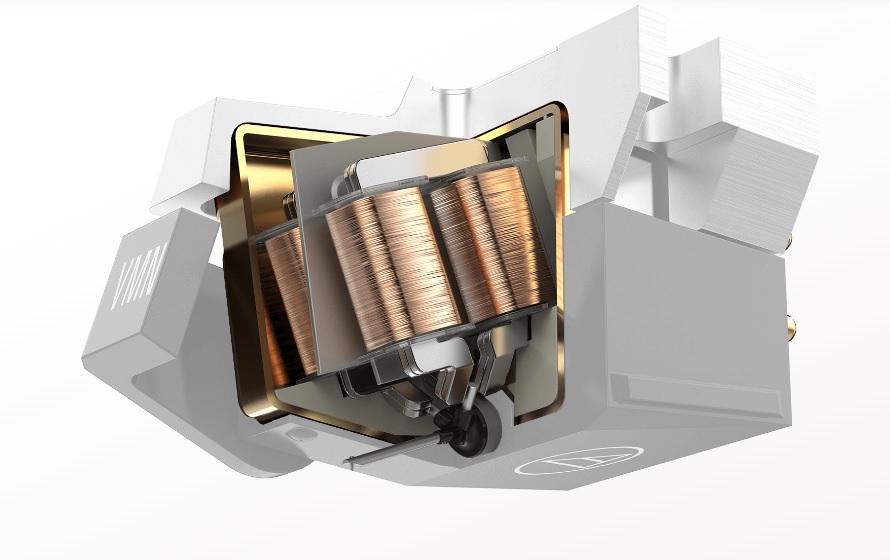
For a cartridge to work effectively, the moving parts (including the magnets) have to be kept light/small, but the coil (being the static part) can be made with many many turns of wire on it so as to be as effective as possible in capturing the induced current. As a result, the output of a typical MM cartridge is in the order of a few millivolts (plenty big enough for the electronics in the phono stage to deal with).
With a moving coil cartridge, in order to keep the coil small & light, it has to have relatively few turns of fine wire and, although the (static) magnet can be made larger and more powerful, the physics dictates that Moving Coil cartridges have output levels significantly lower than their MM alternatives. This, in turn, places a greater burden on the phono stage into which the signal is next fed (and not just the fact that it needs to supply more gain…. but that’s a story for another article).
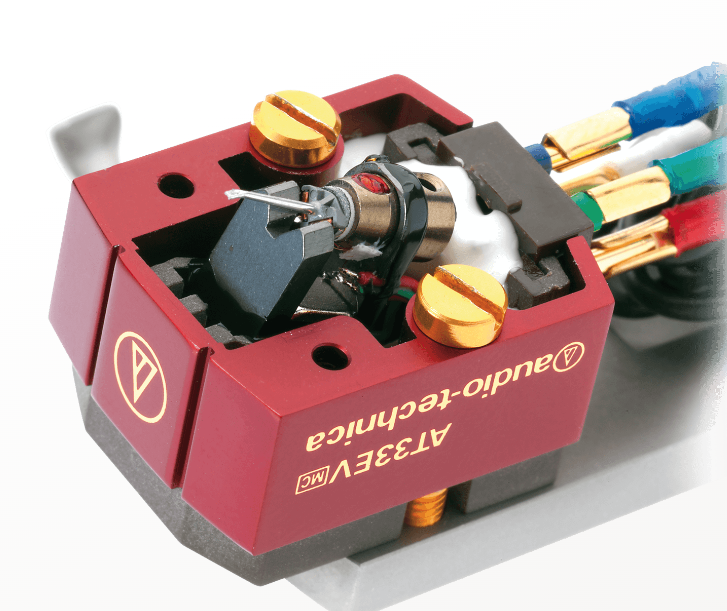
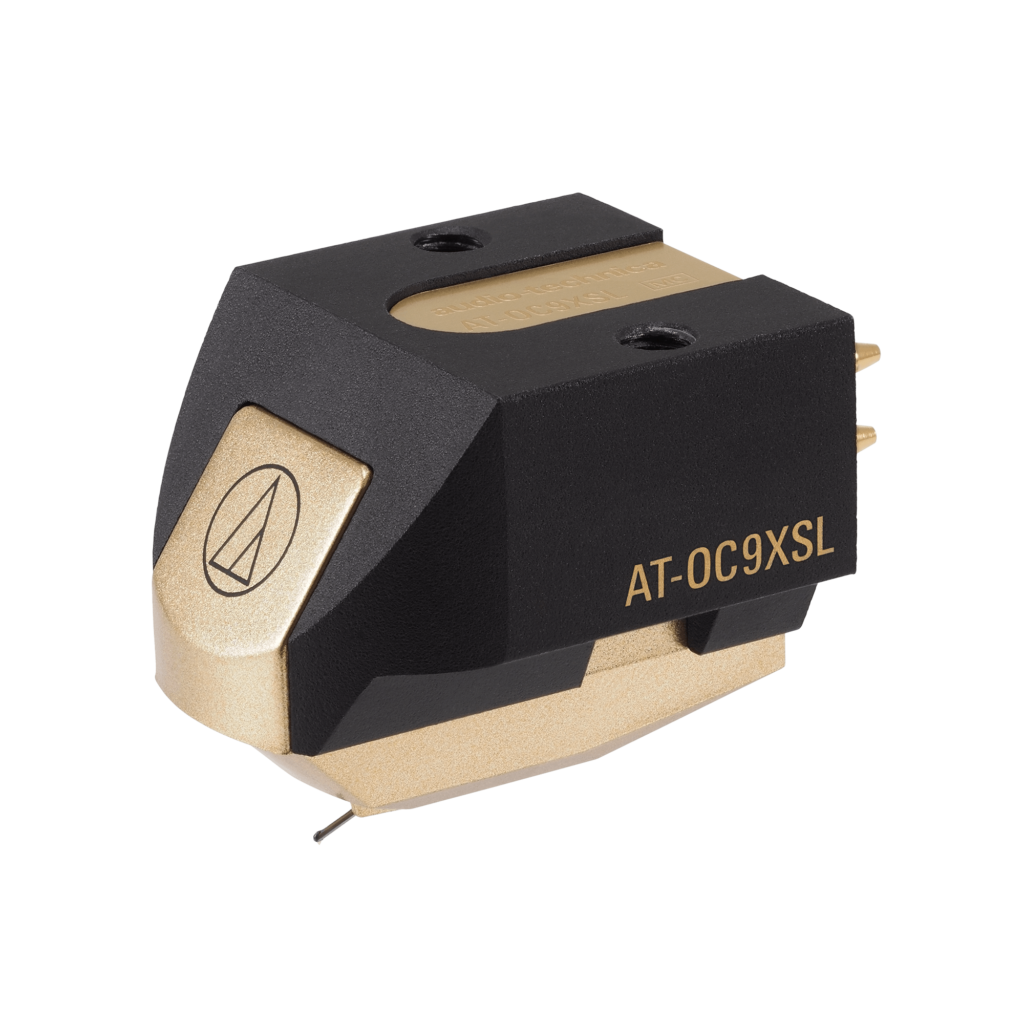
Back to my friend with his now satisfying MC equipped Pink Triangle turntable.. The initial, slightly underwhelming cartridge, being a budget model had a bonded elliptical stylus and a plastic body, a £40 to £50 cartridge in today’s money. The cartridge he replaced it with was an Audio Technica F5 (no longer made, but similar to today’s OC9XEN which has a list price of £310). In fact he had gone one better and shelled out for the Stilton modified version of the cartridge which came with a precision made metal body.
The biggest improvement he had gained was in changing from a bonded stylus to a nude mounted one. You can read more about these differences (HERE) but essentially, he now had a real hifi diamond stylus instead of a steel pin with a scrap of industrial diamond bonded to the end of it. The much lighter mass of the nude diamond would have been making a huge difference to the performance, particularly at higher frequencies – the ones that inform detail, nuance, timing etc.
Further, the solid mount in which the generator sat would have given the whole thing the best chance of doing its job well (if the fit of generator to cartridge body, or body to arm/ headshell allows any microscopic movement, that amounts to lost information during the retrieval process and nothing downstream can recover lost information).
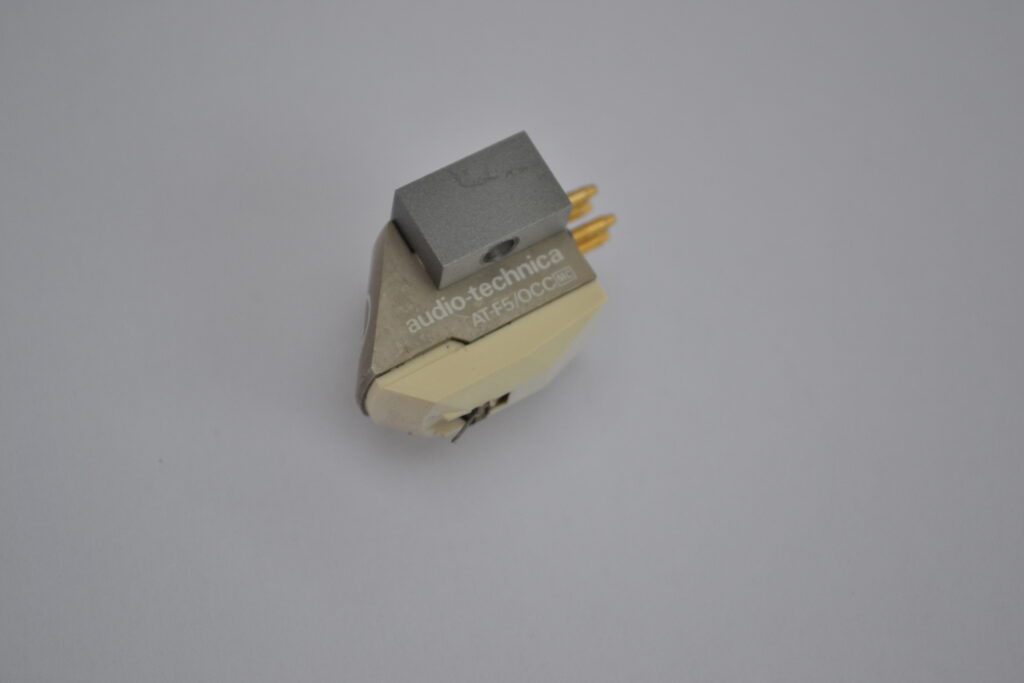
Did the MC ( rather than MM) aspect help with the performance too? Perhaps; but I’m sure that the aforementioned factors were the major ones.
The truth is that if you have a budget of nearly (or definitely) four figures to spend on a cartridge, then you’ll probably be looking at MC options.
But if you are keen to extract as much information as possible from the playing of your records, then go for the best possible stylus profile you can afford first rather than leaping for MC for the sake of it: Nude Elliptical over bonded, Microline or even Special Line Contact, Paratrace et al. will all help to capture information more faithfully than budget stylus types.
Do you play a vinyl for many hours per week? Stylus assemblies are generally replaceable on MM cartridges so a worn out (or accidentally damaged) stylus can be quickly swapped at a lower cost than replacing the whole cartridge.
Due to their construction, this isn’t generally possible with MC cartridges (there were some designs with replaceable styli but they weren’t successful and it didn’t catch on). A worn out MC is, at best, traded in for a discounted or exchange model although retipping is also possible (but neither cheap nor quick).
Despite the many downsides, a move to MC can be worth it. A really good MC cartridge (with a top stylus type) can convey the music with a faithfulness and ambience which is hard to find otherwise. But this also requires a really good phono stage which was designed and built to be optimised for the MC generator.
Sadly, the MC phono stage built into most integrated amps don’t cut it; and neither do most switchable MM/MC separate phono stages in my experience. In fact, a well designed and built MC phono stage will probably cost at least as much as the MC cartridge you were thinking of buying (yes, really!) ,- thus doubling the cost of moving to MC for most people.
Other factors include the fact that allowing a MC cartridge to perform well places a bigger burden on the arm (the MC cartridge imparts more energy into the arm); meaning that turntables with budget arms are better partnered with good MM cartridges.
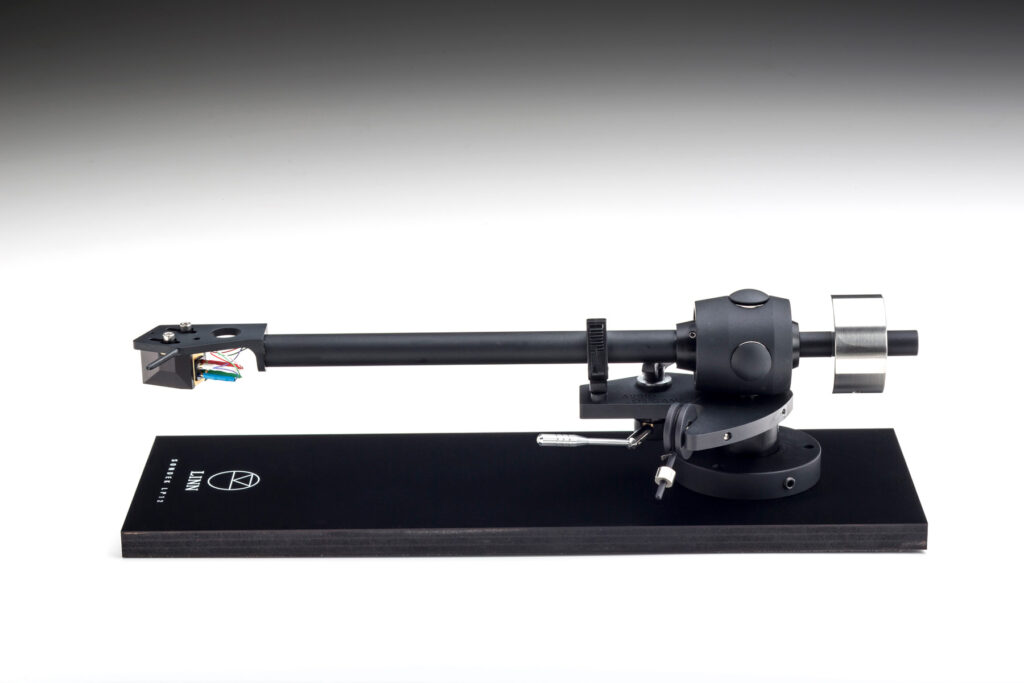
In summary; there’s little point in buying a MC cartridge to upgrade from what you have unless and until turntable, arm and phono stage are all good enough to allow the MC cartridge to work at its best. There is a wealth of MM options which warrant investigation & audition before making the leap to the expensive and inflexible MC route.


Leave a Reply